By Daily Mail Reporter
-70-year-old woman found alive in house that had been washed away by the tsunami
-Japan injects £60.8bn into money markets after Nikkei plunges by more than 10 per cent
-Bread, tinned goods and batteries growing scarce as Japanese panic buy amid nuclear crisis
-Fears for hundreds of Britons believed missing. FO expresses 'serious concern' for at least 50

Wiped out: Rescue workers are dwarfed by the scale of the rubble as they pick their way through the shattered city of Otsuchi
With millions of people without electricity, thousands missing and warnings of an imminent second earthquake, the task for Japanese authorities is too daunting to imagine.
Some 3,000 people have now been confirmed dead since last week’s earthquake and subsequent tsunami but officials believe the death toll could rise into the tens of thousands, with a further 2,000 bodies washing up on the shores of north-east Japan yesterday.
Bodies wrapped in blue tarpaulins were laid on military stretchers and lined up for collection while panic-buying has begun in Japan amid fears of a second quake and growing concern about nuclear leaks.
And tonight there were fresh fears over the possibility of a full-scale nuclear disaster as the operator of stricken Fukushima Dai-Ichi nuclear power plant said a fire has broken out again at its No. 4 reactor unit.
 United in death: The bodies of victims at a village destroyed by the tsunami in Rikuzentakata (left) and the wreckage of Toyota Yaris at the port of Sendai
 Firefighting: Ships try to extinguish a blaze at oil refinery tanks in Ichihara, Chiba Prefecture, which has been burning since Friday's earthquake and tsunami
 Rescue: Japanese relief workers carry a man who survived being buried alive for five days in Ishimaki (left) and a truck dangles from a collapsed bridge in Ishinomaki, northern Japan
 Precarious: A house perches on top of a bridge in Ishinomaki after being swept away by the tsunami
Tokyo Electric Power Co. spokesman Hajimi Motujuku says the blaze erupted early Wednesday in the outer housing of the reactor's containment vessel.
The bad news came as survivors continue to struggle to find food and water as supplies run low. There have been major power outages since the double disaster, many planned to preserve resources.
As the stock market plunges and the government warns it is receiving just a fraction of the emergency aid it needs, it is unclear how Japan can even begin to tackle the destruction.
The level of desolation is on an epic-scale with many towns completely destroyed. A shattered infrastructure makes it almost impossible to move heavy lifting equipment and rescue crews have struggled to reach the worst hit areas.
The death toll from last week's earthquake and tsunami jumped today as police confirmed the number killed had topped 3,300, although that grim news was overshadowed by a deepening nuclear crisis. Officials have said previously that at least 10,000 people may have died in Miyagi province alone.
The International Atomic Energy Agency has confirmed that radiation had been released into the atmosphere after yet another explosion at the Fukushima Daiichi power plant, inside Number 2 reactor.
 Eerie: Cars drive along one of the few passable roads in the devastated Minamisanriku where 10,000 people are feared dead
 People carry the body of a victim through debris in Kesennuma, Miyagi, northern Japan
 Squatting amid the ruins: A woman cooks for her family in front of their devastated house in Ishinomaki in Miyagi Prefecture (left) while an older survivor swaddles herself in blankets and gloves at makeshift shelter at Ofunato, Iwate Prefecture
Explosions had already occurred in the Number 1 and Number 3 reactors. Number 4 reactor is also on fire and there are fears for those who have not yet made it outside the 12-mile exclusion zone.
Rescuers have pulled a 70-year-old woman from her the wreckage of her home , four days after it was demolished in the Japanese quake.
The rescue of the elderly Sai Abe and a younger man pulled from rubble elsewhere in the region were rare good news following Friday's disaster.
Mrs Abe's son said he had tried to save his mother but could not get her to flee her home in the port town of Otsuchi. His relief at her rescue, he said, was tempered by the fact that his father is still missing.
'I couldn't lift her up, and she couldn't escape because her legs are bad,' Hiromi Abe said. 'My feelings are complicated, because I haven't found my father.'
 Ship out of water: A boat dumped in the street in Hishonomaki, Miyagi, after being swept inshore by the tsunami
 Heart of the wasteland: Japanese survivors of Friday's earthquake and tsunami walk under umbrellas through the leveled city of Minamisanriku
 Swept away: A house drifts in the middle of the Pacific Ocean after being hit by the tsunami (left) while people are forced to wash their clothes by a river at Otsuchi, northeastern Japan
 Vanished: An astounding aerial view of the tsunami-devastated town of Rikuzentakata shows the full scale of the damage. Very little remains
 Match stick city: Heavy machines crawl through the rubble in Rikuzentakata (left) while a rescue crew surveys the damage in Ofunato, northeastern Japan
 Mrs Abe was suffering from hypothermia and sent to a hospital, but appeared to have no life-threatening injuries.
Another survivor, described as being in his 20s, was pulled from a building further down the coast in the city of Ishimaki after rescue workers heard him calling for help.
Conditions for those still alive in the rubble worsened as a cold front arrived today, further pushing down temperatures. Snow is forecast over the next few days
Millions of people spent a fourth night with little food, water or heating in near-freezing temperatures as they dealt with the loss of homes and loved ones. Asia's richest country has not seen such hardship since the Second World War.
Hajime Sato, a government official in Iwate prefecture, one of the hardest-hit, said deliveries of supplies were only 10 per cent of what is needed. Body bags and coffins were running so short that the government may turn to foreign funeral homes for help, he said.
Indonesian geologist Hery Harjono, who dealt with the 2004 Asian tsunami, said it would be ‘a miracle really if it turns out to be less than 10,000’ dead.
The 2004 tsunami killed 230,000 people - but only 184,000 bodies were found.
The impact of the earthquake and tsunami dragged down stock markets. The benchmark Nikkei 225 stock average plunged for a second day today, nosediving more than 10 per cent to close at 8,605.15 while the broader Topix lost more than 8 per cent.
To reduce the damage, Japan's central bank made two cash injections totalling 8 trillion yen (£60.8 billion) into the money markets today.
Initial estimates put repair costs in the tens of billions of dollars, costs that are likely to add to a massive public debt which , at 200 per cent of gross domestic product, is the biggest among industrialised nations.
The pulverised coast has been hit by hundreds of aftershocks since Friday, the latest a 6.2 magnitude quake which was followed by a fresh tsunami scare yesterday.
As sirens wailed, soldiers abandoned their search operations and told people on the devastated shoreline to run to higher ground.
The warning turned out to be a false alarm.
‘It’s a scene from hell, absolutely nightmarish,’ said Patrick Fuller, of the International Red Cross Federation.
‘The situation here is just beyond belief. Almost everything has been flattened.’
 Pictures released by NASA shows the Japanese city of Ishinomaki (left) after the tsunami and in 2008 (right). Water is dark blue, plant-covered land is red, exposed earth is tan, and the city is silver.
 Japan Red Cross president Tadateru Konoe added: ‘After my long career in the Red Cross where I have seen many disasters and catastrophes, this is the worst I have ever seen.’
The Japanese government and aid agencies are struggling to ferry food, water and medicines to survivors after panic-buying stripped shelves bare in the few shops left standing.
Far outside the disaster zone, stores are running out of necessities, raising government fears that hoarding may impede the delivery of emergency food aid to those who really need it.
‘The situation is hysterical,’ said Tomonao Matsuo, spokesman for instant noodle maker Nissin Foods, which donated a million items including its Cup Noodles for disaster relief. ‘People feel safer just by buying Cup Noodles.’
The company is trying to boost production, despite earthquake damage which closed down its facilities in Ibaraki prefecture until today.
The frenzied buying is compounding supply problems from damaged and congested roads, stalled factories, reduced train service and other disruptions caused by Friday's magnitude 9.0 earthquake off Japan's north-east coast and the major tsunami it generated.
Officials have been overwhelmed by the scale of the crisis, with millions of people spending a fourth night without electricity, water, food or heat in near-freezing temperatures.
 A ship is seen perched on top of a house in the tsunami devastated remains of Otsuchi, Iwate prefecture
 Details of the scale of the disaster (left) while destroyed houses are seen in the river at a devastated area hit by earthquake and tsunami in Kesennuma (right)
 Ghost town: A once thriving industrial town off the coast in notheast Japan that has now been decimated by the tsunami wave that washed over the region
Officials estimate that 430,000 people are living in emergency shelters or with relatives.
The government has sent 120,000 blankets, 120,000 bottles of water and 29,000 gallons of petrol plus food to the affected areas.
The stock market plunged over the likelihood of huge losses by Japanese industries including big names such as Toyota and Honda following the 9.0 magnitude quake on Friday.
Almost 2million households are without power in the freezing north and about 1.4million have no running water while drivers are waiting in queues for five hours for rationed petrol.
 Grim: The Japanese army search for bodies in Higashimatsushima City, in Miyagi, the state where up to 10,000 people may have died
 Clean up: Police walk in file down a hillside today into a coastal town in northeast Japan that has been flattened by the tsunami wave
Experts are now warning a second huge quake - almost as powerful as the first - could hit the country, triggering another tsunami.
The director of the Australian Seismological Centre, Dr Kevin McCue, told the Sydney Morning Herald that there had been more than 100 smaller quakes since Friday, and a larger aftershock was likely.
'Normally they happen within days.
'The rule of thumb is that you would expect the main aftershock to be one magnitude smaller than the main shock, so you would be expecting a 7.9.
'That's a monster again in its own right that is capable of producing a tsunami and more damage.'
In a rare piece of good news, a 70-year-old woman has been found alive four days after the devastating earthquake and tsunami in north-eastern Japan.
Osaka fire department spokesman Yuko Kotani said the woman was found inside her house which had been washed away by the tsunami in Iwate prefecture.
Her rescuers, from Osaka in western Japan, had been sent to the area for disaster relief.
Ms Kotani said the woman was conscious but suffering from hypothermia and was being treated in hospital. She would not give the woman's name.
Source:dailymail
 Ghost town: A landmark crossroads in Tokyo's Ginza district is eerily dark and empty as people stay indoors after warnings about a radioactive cloud from the stricken nuclear plant 150 miles away
 Dimmer: Buildings in Tokyo turn down the lights as part of electricity saving efforts to avoid massive power outages and, right, its usual neon shine

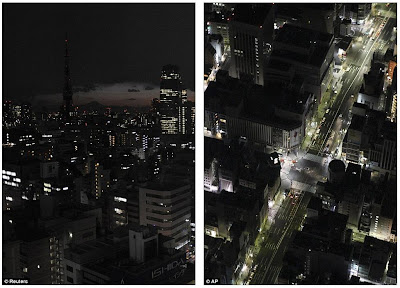 Darkness falls: The usually brilliantly lit skyline has been shrouded in darkness to conserve scant resources of electricity as the crisis continues
 Business is slow: A taxi driver reads a newspaper as he waits for a fare on an empty street
 Contrast: An evacuee from a junior high school studies under the light of a kerosene stove at a makeshift shelter in stricken Ofunato
 Eerie: People weave their way between blacked out high rises. Tokyo faces at much as six months of blackouts


